
Tommy Hilfiger and Tommy Jeans share the same red, white and blue logo, the same stores and sometimes even the same clothing racks. Both lines belong to PVH Corp and were born from the vision of American designer Tommy Hilfiger. Their coexistence raises a legitimate question: is this simply a marketing distinction, or do they offer two genuinely different styles?
From Hilfiger Denim to Tommy Jeans: a name change that shifted the brand’s positioning
Before it became Tommy Jeans, the line was called Hilfiger Denim. The name change, which took place in the late 2010s, was more than cosmetic. Hilfiger Denim suggested a material, a fabric. Tommy Jeans, by contrast, establishes a world of its own, with its own campaigns, collaborations and visual identity, distinct from the parent brand.
The repositioning aimed to tap into nostalgia for the 1990s, a decade when the Tommy Hilfiger logo was ubiquitous in hip-hop culture and American skatewear. By using just the first name (Tommy), the line distances itself from the more formal full name and embraces a closer connection to street culture and youth.
To explore the difference between Tommy Hilfiger and Tommy Jeans in more depth, you need to look beyond the name change and examine what each line actually offers in its collections.
Fits and fabrics: Tommy Hilfiger covers a broader range
Tommy Hilfiger, the parent brand, is about more than denim. Its catalogue includes polo shirts, Oxford shirts, unstructured blazers, chinos, accessories and shoes. Tommy Hilfiger’s range spans smart casual to semi-formal, with more refined finishes and fabrics such as premium cotton and wool blends.
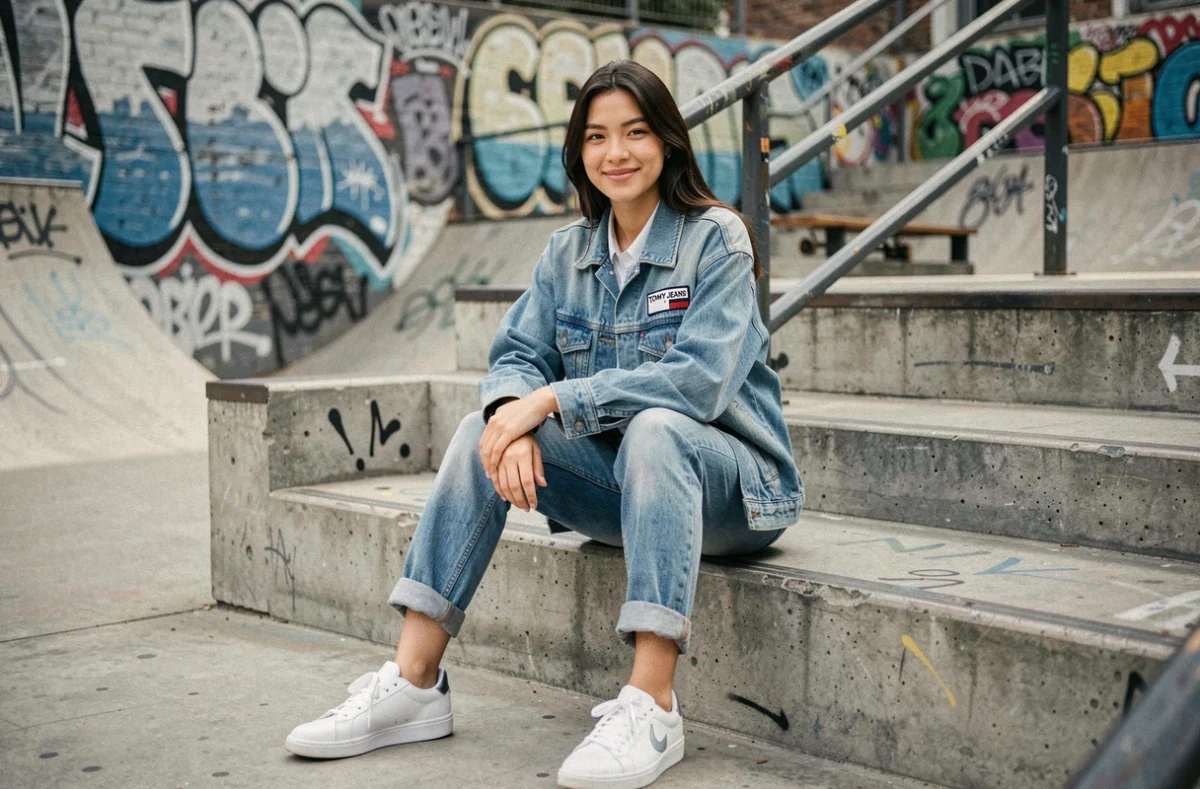
Tommy Jeans focuses its collections on denim, sweatshirts, trucker jackets and T-shirts with prominent logos. The fits are looser, the washes more pronounced and the graphics more prominent. Denim remains the common thread, although the line also offers jersey and nylon pieces.
Both lines offer a range of jeans fits
One often-overlooked point: Tommy Hilfiger also offers jeans, including more than just basic styles. You’ll find a range of fits, from skinny to loose for men and straight to wide-leg for women. The distinction between the two lines isn’t simply about denim, since both offer it. The difference lies more in the styling: raw washes and classic fits at Hilfiger, more pronounced fading and looser silhouettes at Tommy Jeans.
Visual identity and logo placement: two distinct styles
The size and visibility of the logo are the most immediate ways to tell the two lines apart in store.
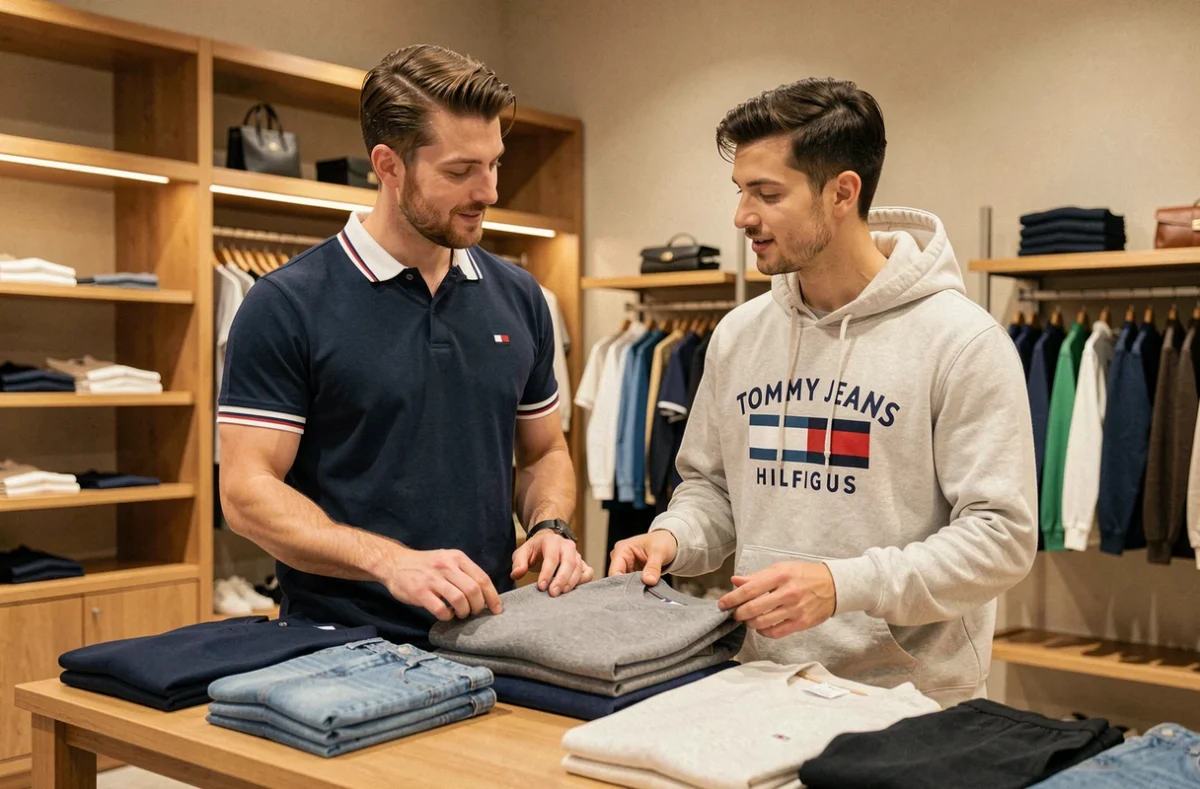
- At Tommy Hilfiger, the logo is discreet: a small flag embroidered on the chest, an inside label or, sometimes, a tricolour stripe at the hem of a polo shirt. The garment speaks through its cut, not its branding.
- At Tommy Jeans, the logo is prominently displayed across the chest or back, often printed or flocked. The pieces visibly proclaim their brand identity, in keeping with 1990s streetwear.
- The colour palettes differ too: Tommy Hilfiger favours navy, off-white and classic red. Tommy Jeans goes for brighter shades, stronger contrasts and less conventional graphic combinations.
This approach to logos is no small detail. It reflects two different ideas about clothing: one where the brand takes a back seat to the wearer’s style, and another where it plays an active role in creating the look.
Price and perceived quality: a real but nuanced difference
Tommy Jeans is generally priced below Tommy Hilfiger. A Tommy Jeans T-shirt costs noticeably less than its Tommy Hilfiger equivalent, and the same difference applies across comparable categories, including sweatshirts, jeans and jackets.
Perceived quality is comparable across the two lines. Both use good-quality fabrics for their market segment. The price difference reflects positioning more than a difference in basic quality: Tommy Hilfiger invests in more refined finishes (engraved buttons, linings and woven labels), while Tommy Jeans focuses on volume and affordability.
Who are they for, exactly?
Tommy Hilfiger targets active adults looking for versatile pieces they can wear to the office or out. American preppy style, with its polo shirts and chinos, remains the brand’s foundation.
Tommy Jeans is aimed at young adults and students, or more broadly anyone who puts together casual outfits centred on denim and sportswear. Age isn’t the only factor: it’s how you plan to wear the clothes that matters. A thirty-something who wears faded jeans at the weekend might well prefer Tommy Jeans to Tommy Hilfiger for that particular occasion.
Choosing between Tommy Hilfiger and Tommy Jeans: it depends on the occasion
Pitting the two lines against each other is often an oversimplification. In practice, many customers own pieces from both collections without seeing any contradiction. A Tommy Hilfiger polo worn with Tommy Jeans creates a cohesive outfit.
- For the office or dinner, Tommy Hilfiger offers more suitable options thanks to its structured fits and dressier fabrics.
- For a weekend, campus or festival look, Tommy Jeans offers bold logo pieces and relaxed fits that better suit these settings.
- When it comes to denim, it’s worth comparing the two lines style by style, because their available fits overlap more than you might think.
The real question isn’t “which brand is better?” but “which garment, for which occasion?” Tommy Hilfiger and Tommy Jeans aren’t competitors: they complement each other in the same wardrobe, each serving a specific style and setting.